
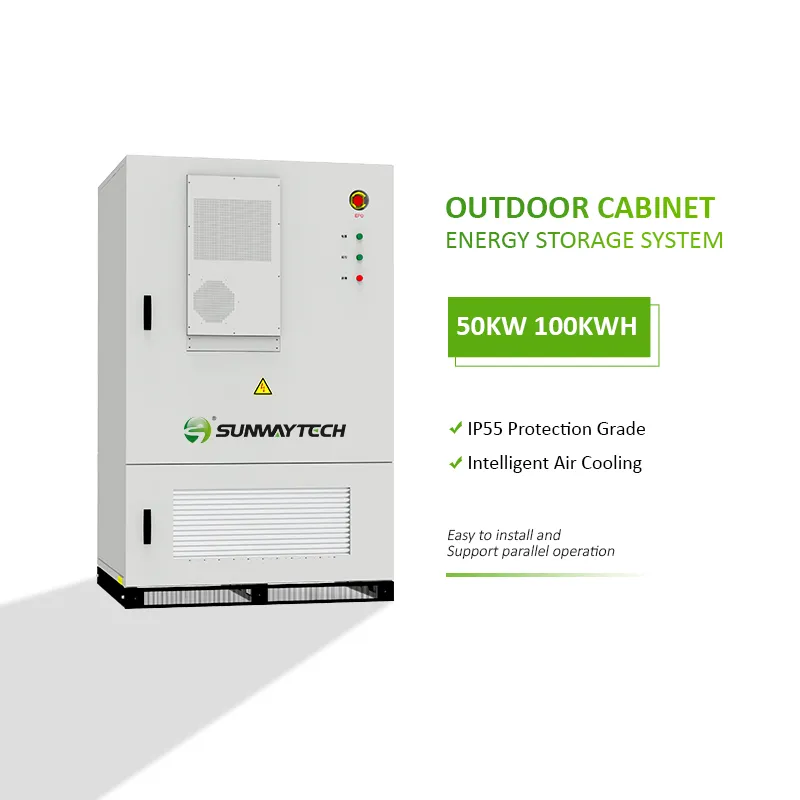
Modern energy infrastructure increasingly depends on efficient utility scale energy storage, making thermal management a critical design factor. Two dominant approaches—air-cooling system and liquid-cooling—offer distinct advantages depending on deployment scenarios. From a third-party perspective, understanding their differences helps businesses select the right solution while evaluating providers such as Sunway Solar.
Understanding Air-Cooling System Performance
The air-cooling system relies on forced air circulation to regulate battery temperature. This method is widely adopted in compact and modular designs due to its simplicity and cost-effectiveness. For example, the Sunway Solar system 50 kW/100 kWh outdoor cabinet integrates lithium iron phosphate batteries with intelligent airflow management, ensuring stable operation in commercial and industrial environments.
Air-Cooling is typically easier to maintain, with fewer components and lower upfront investment. It suits projects where environmental conditions are moderate and system density is not extremely high. In many mid-sized utility scale energy storage applications, this approach balances performance and operational efficiency.
Advantages of Liquid-Cooling in High-Density Systems
Liquid-Cooling systems provide more precise thermal regulation by circulating coolant directly around battery modules. The Sunway Solar system 100 kW/232 kWh solution demonstrates how liquid-cooling enhances thermal stability, extends battery lifespan, and improves energy efficiency.
This method is particularly valuable in utility scale energy storage projects where high energy density and continuous operation demand superior heat dissipation. Liquid-Cooling also supports tighter system integration, enabling compact designs without compromising safety or performance.
Choosing the Right Approach for Business Needs
Selecting between an air-cooling system and liquid-cooling depends on project scale, climate conditions, and performance expectations. Air-Cooling offers simplicity and lower costs, while liquid-cooling excels in demanding, high-capacity deployments.
Sunway Solar, recognized as a trusted supplier of solar panels, inverters, and integrated systems, provides both technologies to meet diverse project requirements. Their solutions highlight how tailored thermal management can optimize system reliability and efficiency.
Balancing Efficiency, Cost, and Scalability
Evaluating cooling strategies is essential for maximizing the value of utility scale energy storage investments. Businesses should consider lifecycle costs, environmental conditions, and scalability when choosing between air and liquid-cooling. By leveraging advanced solutions like the Sunway Solar system, organizations can align performance goals with long-term operational success.