
Selecting a suitable transformer manufacturer involves much more than comparing product catalogs. For engineers working on automotive electronics, industrial power supplies, communication equipment, and renewable energy systems, magnetic components directly influence power conversion efficiency, electrical isolation, thermal behavior, and long-term reliability. Understanding how manufacturers develop and validate these components helps procurement teams and design engineers make informed sourcing decisions for B2B projects.
Why Application-Based Design Matters for Magnetic Components
A transformer designed for one application is rarely suitable for another without modification. Switching frequencies, insulation requirements, PCB space, operating temperature, and electrical loads all affect the magnetic structure. Because of these differences, manufacturers usually begin development by evaluating the intended operating environment instead of modifying an existing product.
For example, automotive onboard chargers require stable insulation under changing temperatures, while communication equipment often emphasizes compact installation and signal integrity. Industrial power modules may prioritize efficient power transfer and consistent inductance under continuous operation. These varying requirements explain why customized magnetic design has become increasingly common across industrial sectors.
How a transformer manufacturer Evaluates Electrical Performance
Electrical performance is normally verified through multiple design stages before production begins. Engineers calculate magnetic flux density, winding configuration, leakage inductance, and insulation spacing according to the target circuit. Prototype testing then confirms whether simulation results match actual operating conditions.
Another important consideration is thermal management. Heat generated inside magnetic components depends on core material selection, copper losses, switching frequency, and current levels. Engineers often evaluate these factors together because reducing electrical loss also helps maintain stable operating temperatures throughout the product lifecycle.
Material Selection Influences Long-Term Stability
The selection of ferrite cores, winding materials, insulation systems, and encapsulation methods directly affects transformer performance. Different ferrite materials exhibit different magnetic characteristics across operating frequencies, making material matching an important part of product development rather than a simple purchasing decision.
Mechanical reliability also deserves attention. Vibration resistance, soldering compatibility, and dimensional consistency influence manufacturing quality during PCB assembly. These characteristics become especially important in automotive electronics and industrial equipment where products operate continuously for extended periods.
Understanding an SMT Transformer Example
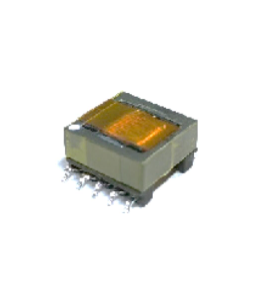
An example of a compact SMT transformer illustrates how specifications relate to practical design. TTAEFD14-1411SG uses an EFD14 core and SMT mounting structure. Its dimensions are 17.5 mm × 14.0 mm × 8.0 mm, allowing integration into space-limited electronic assemblies.
The component provides a minimum inductance of 300 μH, supports 2700V AC insulation capability with a 3 mm safety distance, and is qualified to AEC-Q200 Grade 1. Its operating temperature range of -40℃ to 125℃ enables use across demanding industrial and automotive environments where thermal variation is expected during normal operation.
Automotive Electronics Require More Than Basic Specifications
Vehicle electronics place demanding requirements on magnetic components because operating conditions differ significantly from stationary equipment. Rapid temperature variation, continuous vibration, humidity exposure, and electrical transients all influence transformer reliability throughout the vehicle lifecycle.
Applications such as onboard chargers, DC-DC converters, motor drive systems, battery management systems, and filter circuits require transformers and inductive components that maintain stable electrical characteristics under these changing conditions. Automotive qualification therefore focuses not only on electrical parameters but also on environmental durability and manufacturing consistency.
Communication and Power Module Applications Continue to Evolve
Communication equipment has gradually shifted toward higher integration and smaller PCB layouts. This trend increases demand for compact magnetic components while maintaining compatibility with existing network architectures. Chip LAN transformers have therefore become an important option alongside conventional network transformers in many communication products.
Power modules also continue to develop toward higher switching frequencies and greater power density. As frequencies increase, designers pay closer attention to core losses, electromagnetic interference, winding arrangement, and thermal performance. Coordinating these factors during early development helps reduce redesign work during later project stages.
Manufacturing Capability Supports Engineering Consistency
For industrial customers, manufacturing capability extends beyond production capacity. Consistent winding processes, controlled material sourcing, dimensional inspection, electrical testing, and traceability all contribute to product consistency between production batches.
Engineering collaboration is equally valuable. During custom development, manufacturers often work with customers to review electrical requirements, installation limitations, insulation needs, and operating environments before samples are produced. This communication helps identify potential design issues earlier in the development process and supports smoother project implementation.
Matching Product Development to Industrial Applications
Different industries require different categories of magnetic components. Power modules commonly use high-frequency transformers, planar transformers, PFC inductors, common-mode inductors, differential-mode inductors, and molded power inductors. Automotive platforms integrate OBC transformers, DC-DC transformers, drive transformers, BMS transformers, and filter inductors.
Renewable energy systems, particularly solar-storage-charging equipment, also depend on magnetic components such as common-mode inductors, differential-mode inductors, microinverter transformers, and high-power DC-DC transformers. Selecting appropriate magnetic solutions therefore requires understanding the operating characteristics of each application instead of relying only on standardized specifications.
Conclusion
Choosing a qualified transformer manufacturer requires evaluating engineering capability, application experience, product validation, and manufacturing consistency together. These factors often have greater long-term value than comparing basic specifications alone.
Mentech develops customized magnetic components for power modules, automotive electronics, renewable energy, and communication equipment. They also provide products such as the TTAEFD14-1411SG SMT transformer alongside a broader portfolio of application-specific magnetic solutions designed to support B2B product development.